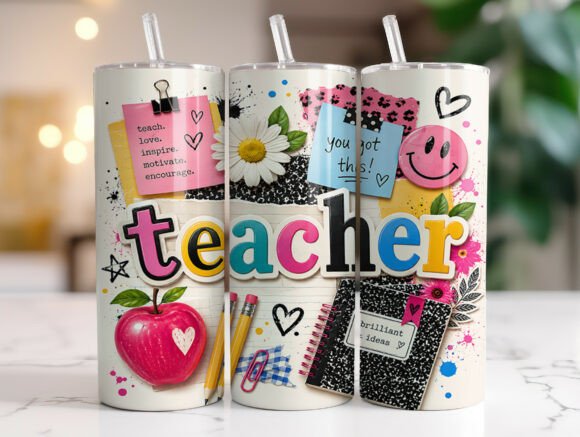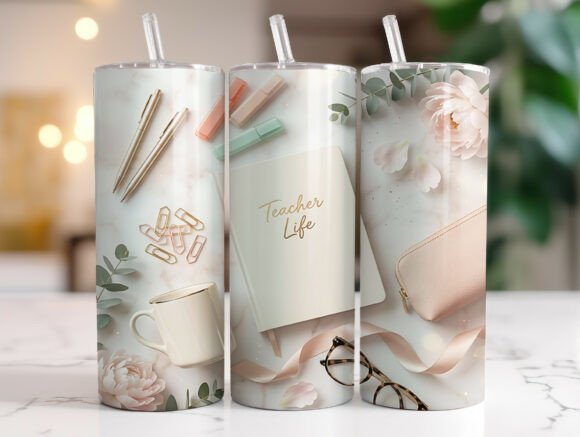
Review: PE Teacher 20oz Skinny Tumbler Wrap for Embroidery
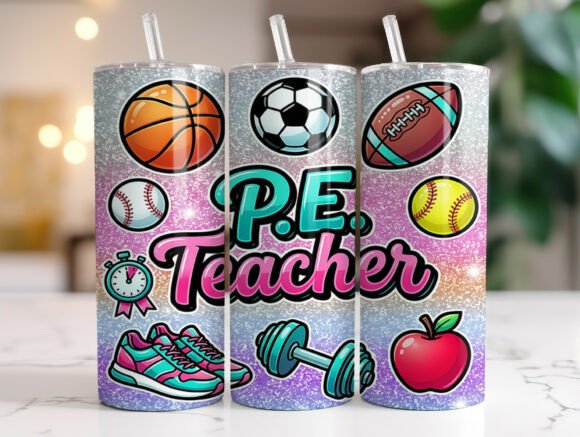
As a designer who spends more time staring at stitch simulations than actual fabric, I approach new design assets with a healthy dose of skepticism. We often see files labeled for one purpose that are secretly versatile enough for another. Today, I am evaluating the PE Teacher 20oz Skinny Tumbler Wrap. While the title explicitly markets this as a sublimation or print graphic for Tumbler Wraps, my eye immediately went to its potential as a foundation for a physical embroidery project. The question isn't just whether it looks good on a screen; it is whether this layout can survive the needle and thread treatment in a real-world craft business setting.
First Impressions: Layout and Visual Personality
Upon opening the file, the first thing that strikes me is the dimensional awareness built into the artwork. The package includes both a straight PNG and a tapered PNG, sized at 9.3″ x 8.2″ with a high resolution of 300 DPI. For an embroiderer, these dimensions are generous. The aspect ratio suggests a design meant to wrap around a cylinder, but when flattened, it offers a substantial canvas for custom apparel or large-format handmade products.
The theme radiates energy and organization, fitting for a physical education professional. The visual personality is bold, likely utilizing strong lines and clear typography to ensure readability from a distance. In the context of embroidery, this is crucial. Designs that rely on subtle gradients often fail when translated to thread, but a graphic with strong definition usually translates beautifully into satin stitch borders and dense fill stitch areas. The mood is professional yet playful, making it an ideal candidate for end-of-year teacher gifts or boutique staff uniforms.
Real-World Application: Beyond the Tumbler
Let's move away from the theoretical and look at a specific scenario. Imagine a local elementary school approaching your small shop product line for staff appreciation week. They want something durable, not a ceramic mug that will break in a gym bag. This is where repurposing the PE Teacher 20oz Skinny Tumbler Wrap becomes a strategic move.
I envision taking the central motif from this graphic and digitizing it for a heavy-weight cotton tote bag. The 9.3-inch width allows the design to span almost the entire front of a standard grocery-style tote, creating a statement piece. Alternatively, consider a sweatshirt embroidery project. Placing this design on the back of a crewneck sweatshirt, perhaps scaled down slightly to fit a 10x10 hoop, would create a fantastic team uniform for the PE department. The taper included in the file is particularly interesting; if you are adventurous, you could use that curvature data to guide your digitizing for a curved surface like a baseball cap, ensuring the text doesn't distort when stitched over the crown.
For those running an Etsy seller account focused on personalized gifts, this graphic serves as an excellent base for a "Teacher Survival Kit" bundle. You could offer an embroidered apron for the craft room or a sturdy canvas lunch bag. The key here is recognizing that a file sold as a Graphics product for printing can often be the perfect reference image for creating a unique digital embroidery file that stands out in a saturated market.
Technical Considerations for Stitching
However, we must address the technical realities. Just because a PNG looks crisp at 300 DPI does not mean it is ready for the machine. If you plan to use this image as a reference for manual digitizing or auto-digitizing software, you need to be mindful of stitch density. Graphics designed for print often include fine details and small text that simply cannot hold up under a needle.
Before committing to a final finished product, you must test the design on scrap fabric. Pay close attention to the smallest elements. If the original graphic has tiny lettering explaining "Hydration Station" or similar phrases, you may need to simplify these into block letters or remove them entirely to prevent bird-nesting. On textured fabrics like pique polo shirts or terry cloth towels, fine details disappear. In these cases, increasing the pull compensation and using a heavier stabilizer is non-negotiable.
Furthermore, consider the thread colors. Print files often use gradients to create depth. In embroidery, you must translate these gradients into distinct color blocks. A smooth gradient in a PNG might need to become a stepped transition of three or four thread shades to maintain the visual appeal without causing excessive thread breaks or trimming. Always check how the design performs in a black-and-white mockup first; if the contrast disappears in grayscale, your stitched version will lack definition on dark garments.
Navigating Fabric and Hoop Constraints
The size of this asset—nearly 10 inches wide—presents a logistical challenge. Not every home embroiderer has access to a jumbo hoop. If you are working with a standard 5x7 or 6x10 machine, you will need to split the design. This requires precise alignment marks and a keen eye for registration. For baby embroidery or smaller items like pocket tees, you will definitely need to scale the design down significantly. Be warned: shrinking a complex graphic too much can turn delicate lines into a solid blob of thread. Always verify the minimum legible size before offering it as a option for baby clothes or small accessories.
Additionally, think about the end-user experience. A PE teacher is active. Their gear gets washed frequently, tossed in gym bags, and exposed to sweat. If you are creating a holiday embroidery gift or a year-round uniform using this design, durability is paramount. Use high-quality polyester threads that resist fading and ensure your backing is cut cleanly to prevent skin irritation. For items like embroidered patches that might be ironed onto jackets, a merrow edge or a tight satin border will protect the internal stitches from fraying during rigorous activity.
Enhancing Brand Value and Customer Trust
Ultimately, the decision to use the PE Teacher 20oz Skinny Tumbler Wrap as a basis for embroidery comes down to perceived value. When a customer sees a cohesive, well-executed design on a high-quality garment, it builds trust in your craft business. It shows that you understand not just how to operate a machine, but how to curate art that fits a lifestyle. Whether you are producing commercial embroidery runs for a school district or single personalized gift items for a parent-teacher association, the professionalism of the source material matters.
This specific graphic offers a niche appeal that generic clip art lacks. It speaks directly to a specific profession, allowing you to target your marketing more effectively. By adapting this printable mockup into a tactile, stitched reality, you add a layer of luxury and permanence that ink cannot match. It transforms a digital download into a heirloom-quality item that a teacher might actually wear with pride.
Final Designer Notes and Licensing
Before you fire up your digitizing software, there are critical administrative steps to take. Since the product description states this is an INSTANT DOWNLOAD containing digital files only, you must verify the licensing terms regarding commercial use for physical goods. Some creators allow their graphics to be printed on tumblers but restrict their use in digitized embroidery for resale. Always read the fine print or contact the creator to confirm you have the rights to create derivative works like machine embroidery design files.
Also, remember that you are receiving PNGs, not vector files. While 300 DPI is excellent for print, tracing these in your digitizing software requires care. Zoom in to ensure your nodes follow the true edge of the pixel art, not the jagged stair-steps of the raster image. Clean up your paths manually to ensure smooth running stitch outlines and clean fill areas.
In conclusion, the PE Teacher 20oz Skinny Tumbler Wrap is a robust asset with untapped potential for the creative entrepreneur. It bridges the gap between digital graphics and tangible textiles. With careful digitizing, appropriate fabric selection, and a focus on durability, this design can anchor a successful line of custom apparel and accessories. It is a reminder that in our industry, inspiration often comes from looking at a file intended for one medium and imagining how it could thrive in another.